
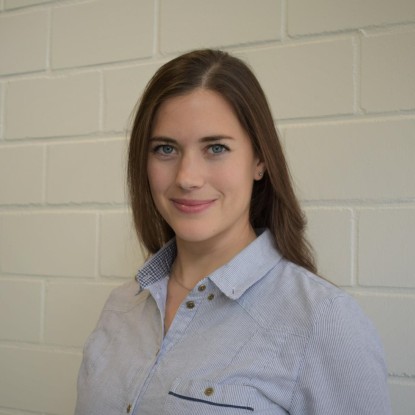
Dr.-Ing. Cordula Czwick (geb. Auth)
Contact
czwick@plcm.tu-...
work +49 6151 16-21842
fax +49 6151 16-21793
Work
L1|01 3
Otto-Berndt-Straße 2
64287
Darmstadt
Cordula Czwick studied at Technische Universität Darmstadt until October 2016 and achieved the Master of Science degree. In her master's thesis she developed a method to analyse the efficiency between conventional and additive manufacturing.
Since January 2017 she has been employed as a research associate at the Department of Computer Integrated Design (DiK).
From the summer semester 2017 until April 2019, Mrs. Czwick supervised the lecture “Virtual Product Development C” in the master's program. At present, she is responsible for the lecture “Introduction 3D-Printing and Additive Manufacturing”.
Additive Manufacturing
The research focus of Mrs. Czwick is additive manufacturing. Additive manufacturing methods offer the possibility to manufacture products and parts, which cannot be built with any other manufacturing method or only with high manufacturing costs. Besides the advantages of function integration and the manufacturing of parts with high component complexity without additional costs, the process chain of additive manufacturing methods allows the efficient production of small lot sizes compared to conventional manufacturing. In the center of the research focus is the digital process chain with the creation of 3D-CAD geometry data, the pre-processing, the building process and the post-processing. This process chain is enlarged trough the phases of the material production, the use and the component recycling to realize a holistic implementation of the component life cycle. These phases are represented in a real demonstrator, which serves the study of process monitoring and quality control through the collection and analysis of process data. Besides, Mrs. Czwick is responsible for the additive manufacturing equipment available at DiK. This equipment can be used for student projects or research projects to manufacture components by means of Fused Layer Modeling (Component Material: ABS). For any questions to this subject please contact Mrs. Czwick directly.
ArePron – agile resource efficient production network
Since January 2018, Mrs. Czwick is managing and working on the transfer project “ArePron – agile resource efficient production network” on the part of the Department of Computer Integrated Design (DiK). The project is approved by the Hessian Ministry of Economics, Energy, Transport and Regional Development (HMWEVL) and financed by the European Regional Development Fund (ERDF) and the Hessian Ministry. The project is a collaboration between the Department of Computer Integrated Design, the Department of Material Flow Management and Resource Economy and the Institute of Production Management, Technology and Machine Tools. The aim until the end of the project in December 2020 is the increase of the resource efficiency with the help of an intelligent, cross-location linking of production systems. Technologies of digitalization improve the resource efficiency and, therefore, reduce costs while they reduce the ecological footprint of the company. With the help of collected, analyzed and conserved data, the resource efficiency of a manufactured part can be determined and optimized. On the part of the Department of Computer Integrated Design, the information and communication infrastructure is developed and implemented, which enables the collection und usage of data. In the end of the project, workshops and guidelines help to transfer information into the companies.
- Conception and design of a demonstrator for the handling of components in the process chain of additive manufacturing (Advanced Design Project)
- Design and Manufacturing of Hierarchical Multi-Functional Materials via High Resolution additive Manufacturing (Masterthesis)
- Development of a rule-based design approach for the product development process for additive manufacturing with fused deposition modeling (Bachelorthesis)
- Development of a systems concept for an automated post-process in additive manufacturing (Masterthesis)
- Conception and design of a shredder for additively manufactured components using the fused deposition modeling (FDM) (Advanced Design Project)
- Development of a method for optimizing and concretizing of process steps in additive manufacturing using Wire Arc Additive Manufacturing (WAAM) (Masterthesis)
- Development of a method for the communication design between process participants in the additive manufacturing lifecycle (Bachelorthesis)
- Development of method to increase the resource efficiency in the additive manufacturing lifecycle (Masterthesis)
- Further development of the function owner catalogue for additive manufacturing with development of a lever-shaft-integration at Airbus Helicopters (Masterthesis)
- Development of a utilization concept for additive manufacturing methods at Mercedes-Benz production plant Mannheim (Masterthesis)
- Development of a method for the identification of influencing factors on the quality and process stability of powder processing technologies of additive manufacturing (Masterthesis)
- Development of a method for expanding product capabilities towards smart products (Masterthesis)
- Development and Implementation of a Concept for Detection of Product Quality trough Data Acquisition and Utilization (Masterthesis)
- Development of a potential analysis for additive manufacturing processes with recommendations for the targeted use of technology (Masterthesis)
- Comparison and evaluation of the influence of Digitization on additive and conventional manufacturing (Masterthesis)
- Development of a method for the evaluation of sustainability of metal-working additive and conventional manufacturing (Masterthesis)
- Development of a procedure model for the connection of an existing production to a platform (Masterthesis)
- Development of a method for the targeted selection and installation of an IoT-platform (Masterthesis)
- Method for the user-oriented and target-oriented design of user interfaces (Bachelorthesis)
- Development of new business models through the use of product service systems (Studienarbeit)
- Scientific analysis of criteria and influencing variables on selected topics in selective laser melting (Advanced Research Project)
- Construction and development of an individual additively producible crank for a bicycle (Advanced Design Project)

Error on loading data
An error has occured when loading publications data from TUbiblio. Please try again later.
-
; {{ creator.name.family }}, {{ creator.name.given }}{{ publication.title }}.
; {{ editor.name.family }}, {{ editor.name.given }} (eds.); ; {{ creator }} (Corporate Creator) ({{ publication.date.toString().substring(0,4) }}):
In: {{ publication.series }}, {{ publication.volume }}, In: {{ publication.book_title }}, In: {{ publication.publication }}, {{ publication.journal_volume}} ({{ publication.number }}), ppp. {{ publication.pagerange }}, {{ publication.place_of_pub }}, {{ publication.publisher }}, {{ publication.institution }}, {{ publication.event_title }}, {{ publication.event_location }}, {{ publication.event_dates }}, ISSN {{ publication.issn }}, e-ISSN {{ publication.eissn }}, ISBN {{ publication.isbn }}, DOI: {{ publication.doi.toString().replace('http://','').replace('https://','').replace('dx.doi.org/','').replace('doi.org/','').replace('doi.org','').replace("DOI: ", "").replace("doi:", "") }}, Official URL, {{ labels[publication.type]?labels[publication.type]:publication.type }}, {{ labels[publication.pub_sequence] }}, {{ labels[publication.doc_status] }} - […]